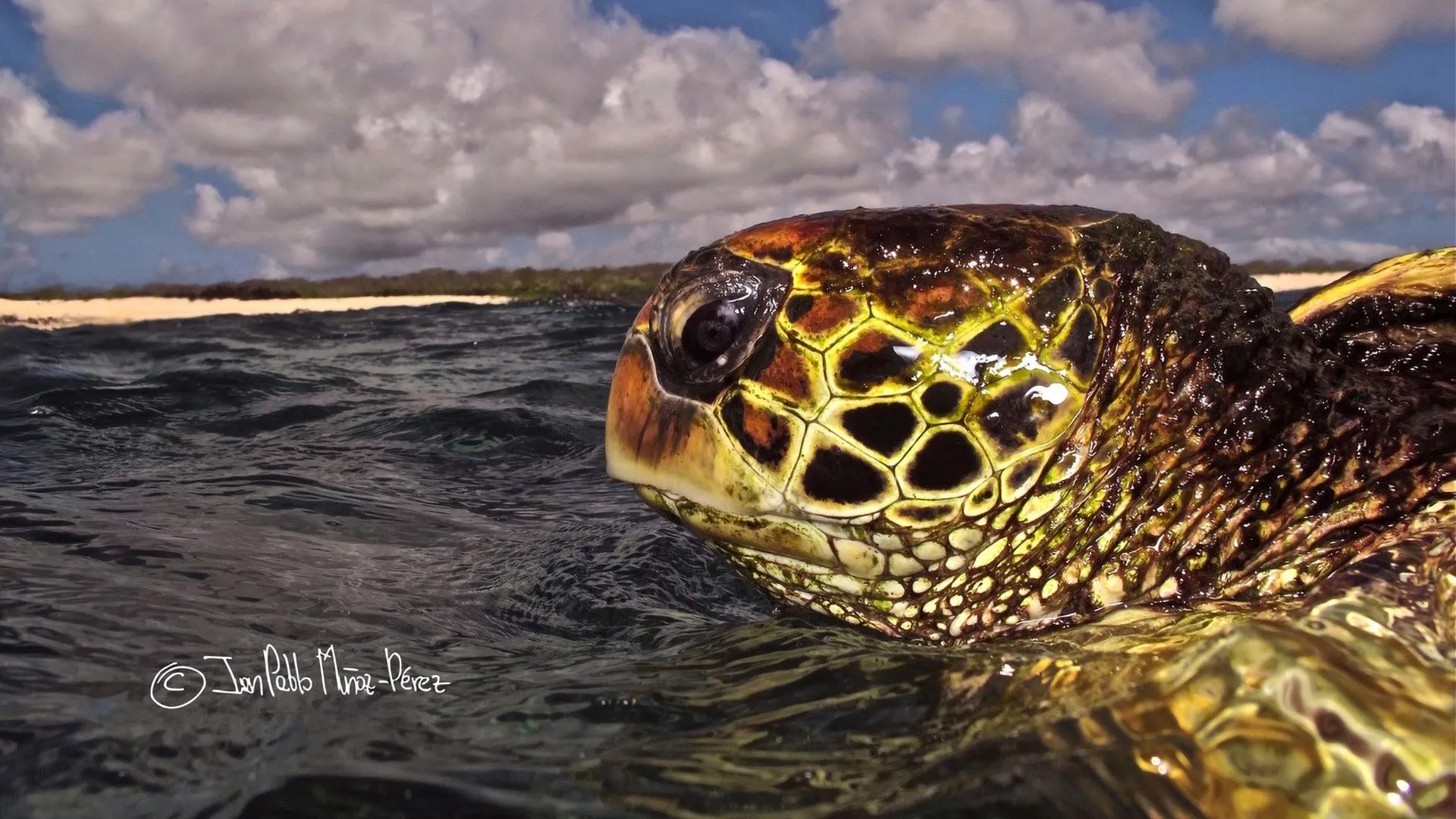
We usually think of sea turtles as globe-trotting adventurers, navigating the oceans using Earth's magnetic field and the sun to find food and breeding grounds. But it turns out, some Galápagos sea turtles are more like homebodies, shattering expectations.
Not So Much Roaming
Scientists have discovered a population of 'yellow-morph' green sea turtles in the Galápagos Islands that don't really go anywhere far. Dr. John W Rowe, a professor at Alma College and lead author of the study published in Frontiers in Amphibian and Reptile Science, explained that these turtles occupy specific feeding spots around one or more islands within the Galápagos Marine Reserve. "Interestingly, none of our satellite-tagged turtles even left the Galápagos Marine Reserve over the three years of our study," he noted. This is a big surprise because these turtles are often expected to migrate to distant beaches in the western Pacific to reproduce.
Green sea turtles are mostly vegetarian as adults, munching on seagrasses and algae. The Galápagos is unique because both yellow and black morphs of green sea turtles live there, hanging out and eating the same marine plants. While young yellow morphs seem to grow faster, scientists are still figuring out the exact differences between the two types.
Tracking Their Moves (or Lack Thereof)
To figure out where these yellow morphs spent their time, researchers tagged nine adult turtles (seven males, two females) in 2015. They tracked them using electronic transmitters for up to 418 days. The results showed these turtles prefer shallow coastal waters and mostly stayed close to the islands, sometimes traveling up to 25km from shore, but rarely much further.
Five of the nine turtles basically stayed put near a single island. Others like Bernardo and Sara moved between Isabela and San Cristóbal, while Leandro hopped between Isabela and Española. Ainoa was the most traveled, moving between San Cristóbal, Santa Cruz, and Isabela. Interestingly, these island-hopping adventures only happened during the cooler months, from April to October.
On average, each turtle had a home range of about 1,498 sq km. The study highlights that these Galápagos yellow morphs can be surprisingly homebound.
What It Means for Conservation
Even though the study only looked at a limited time, the findings have major implications for protecting these creatures. Co-author Dr. Juan Pablo Muñoz Pérez from Universidad San Francisco de Quito mentioned that since female yellow morphs aren't known to lay eggs in the Galápagos, they might eventually leave for the western Pacific. However, black morphs do nest there and some might be year-round residents.
"Since individual turtles may rely on waters around multiple islands, the quality of habitat that is available for foraging should be maintained intact across all islands, and not allowed to degrade anywhere," said Rowe. This means conservation efforts need to protect not just one spot, but the whole network of coastal waters and routes between islands that these turtles depend on.
Why it matters
Understanding the travel habits of these amazing creatures is key to keeping them safe. If they’re sticking closer to home than we thought, conservation plans need to focus on protecting those specific areas and the pathways between them to ensure their survival.